Case study
The only lanyard factory in Qatar, and the first one search finds
Lanyardy makes lanyards, badges and wristbands at its own factory in Al Wukair, for events from the Formula 1 Grand Prix to Qatar Foundation's convocation. Its site had to prove that to a buyer in seconds, and let the team keep it current themselves. We designed it in Relume and Figma and built it on Webflow, with a CMS the client runs.
- Client
- Lanyardy
- Industry
- Manufacturing & events
- Location
- Doha, Qatar
- Services
- Design · SEO · AI Visibility
01 · The challenge
A real factory, indistinguishable online from print shops that outsource
Lanyardy is a manufacturing brand within Eques Holding Group, with its own plant in Birkat Al Awamer, Al Wukair: heat-transfer sublimation lines for lanyards and wristbands, UV printing for badges, a thousand lanyards in about four hours and twenty thousand in forty-eight. Since 2024 it has supplied the Qatar Economic Forum, the Formula 1 Qatar Grand Prix, Google Cloud Summit Doha and Qatar Museums. Online, none of that showed. A search for lanyards in Qatar returned generalist print and promotional-gift shops that take the same orders and send the production elsewhere, and nothing on the web told a buyer who actually owned the machines. There was no page that answered the questions an event organiser asks before ordering, material, width, attachments, minimum quantity and turnaround, and no way for the team to publish a new event or article without going through an agency.
02 · Objectives
What we set out to do
- Make the factory the story: capacity, materials and turnaround visible before a visitor scrolls.
- Answer the buyer's specification questions on every product page, in a form search engines and AI assistants can quote.
- Hand the client a CMS they can publish from, portfolio and blog included, with no developer in the loop.
- Put a route to WhatsApp or a quote form one tap away on every page, on a phone.
03 · Discovery
How we found the real problem
Two buyers, one behaviour. Event agencies and organisers order on a deadline, often days before the doors open; office administrators run ID programmes and reorder. Both search on a phone and both want the same five facts before they talk to anyone: what it is made of, how wide, which clip, how few they can order, how fast it ships. The competitors were generalists selling everything from mugs to banners: none stated a production method or a capacity, none carried structured data, none named the events it had supplied. Lanyardy's advantage was entirely physical, the plant, the machines and the client list, so the site's job was to make the physical visible. Discovery also produced the specification tables, one per product, written from the factory floor rather than a brochure: material, accessories, sizes and production method for lanyards, badges and wristbands.
“Lanyardy's advantage was physical: the machines, the factory, the client list. The site's only job was to make that visible to someone searching on a phone with a deadline.”
The brief, in two lines
04 · Strategy
The plan we committed to
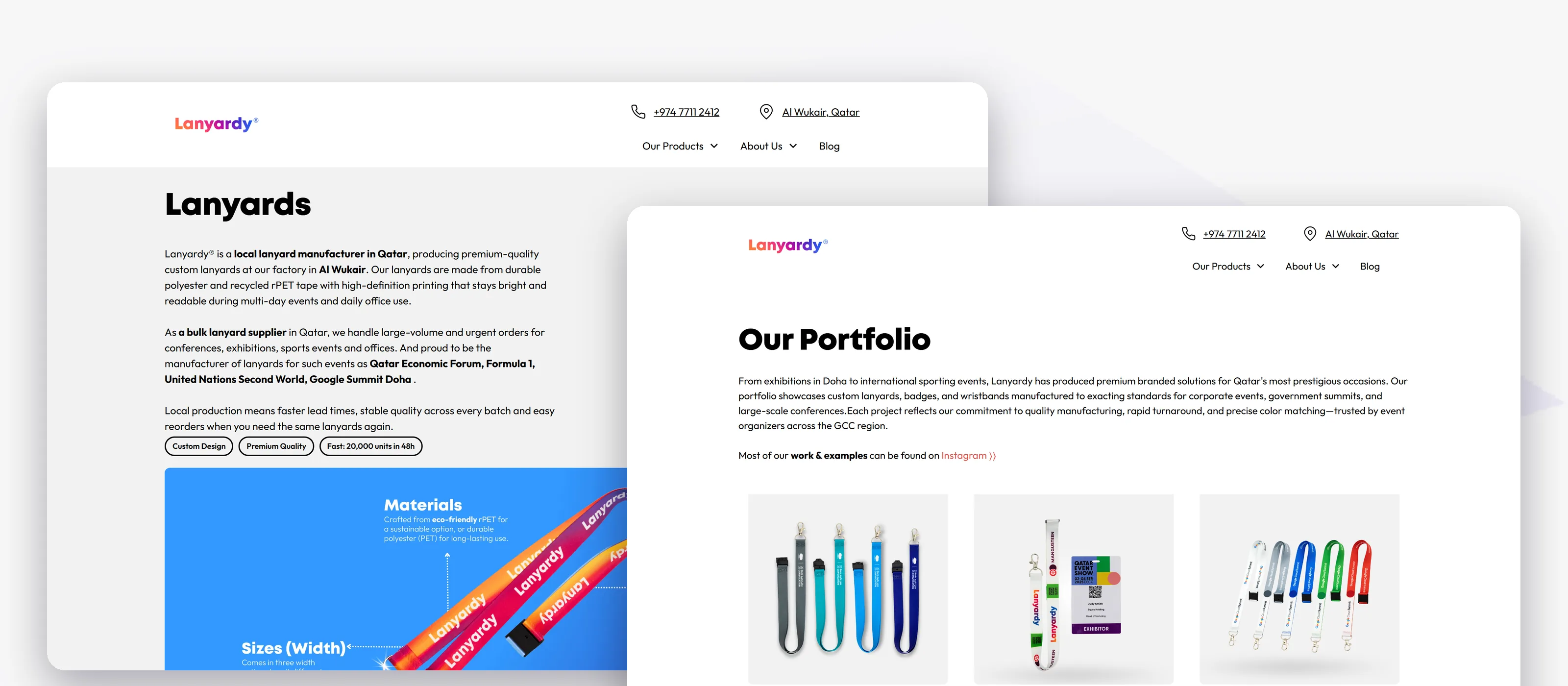
Four decisions. Webflow rather than a custom build: the client's need to publish for themselves outweighed anything a bespoke stack would add, and Webflow's CMS and hosting meant no server to look after and an editor the team could learn in an afternoon. Structure the site around the three products, with each product page written as a standalone answer: an opening paragraph that names the factory and the events, the specification table, then sections on capacity, materials and customisation, ending on a quote form. Name the events. The portfolio is a CMS collection, so every event becomes its own page with tags, photographs and the quantities produced, the kind of specific, verifiable claim that search engines and AI assistants reward. And make asking effortless: a WhatsApp button in the hero, a sticky WhatsApp bar on mobile, and a quote form that takes quantities per product so the first reply can already carry a price.
05 · Design
The decisions behind the screens
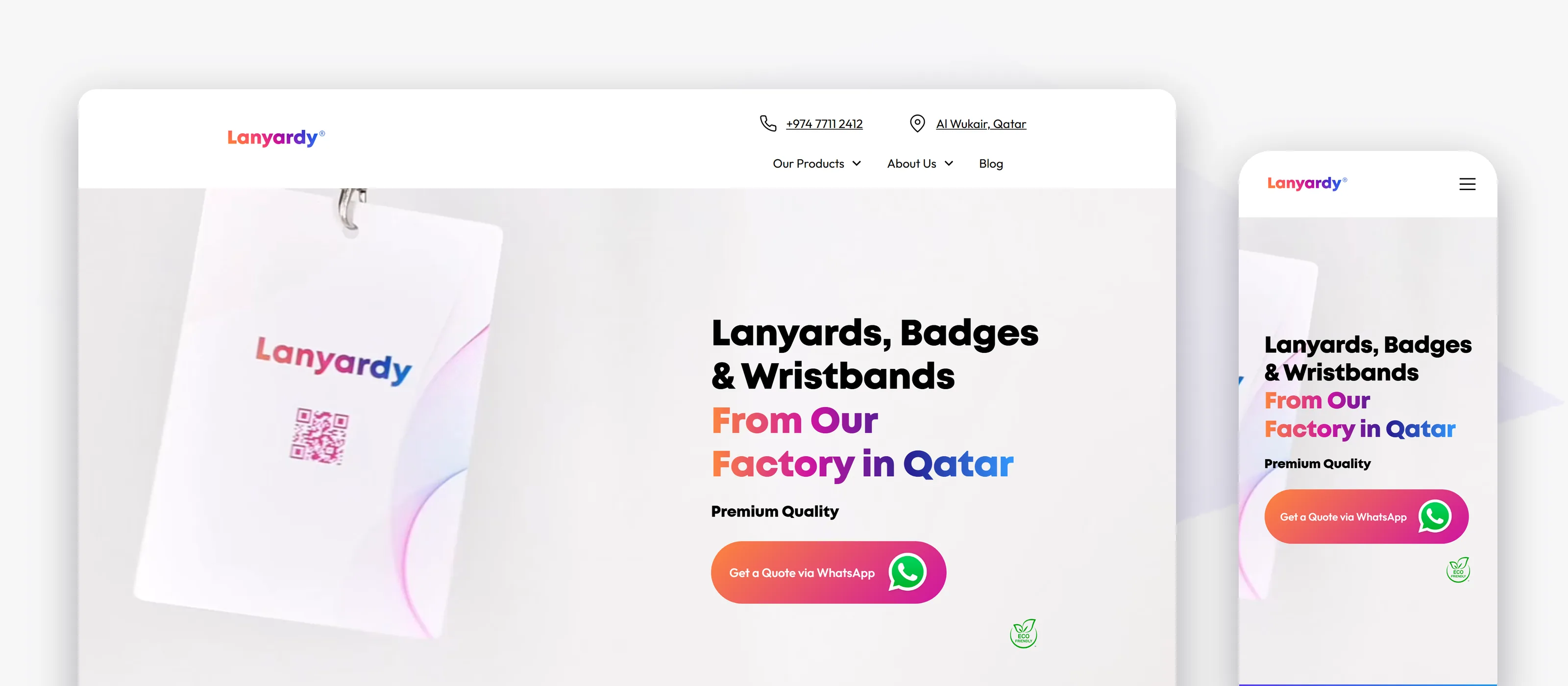
The design started as Relume wireframes, was finished in Figma and then rebuilt in Webflow, section for section. Lanyardy's brand is a gradient, orange through magenta and violet to blue, the colour of its own sublimated tape, and the site spends it carefully: the wordmark, the second line of the hero headline and the one button that matters. Everything else is quiet, off-white grounds with black Mont headings and Outfit body text, pill-shaped tags with hairline borders, generous radii, product photography on pale grey. The hero is a looping clip of a badge turning on its lanyard. Each product page carries an annotated diagram of the item on a deep blue field, materials, widths and production process labelled around the product itself, so the specification is a picture as well as a table. On mobile the gradient reappears once, as a sticky bar that opens WhatsApp. A strip of agency logos and a five-step process, quote, design and sample, production, quality control, delivery, tell an organiser what happens after they press the button.
How we approach Design & Development
06 · Development
What we built it on
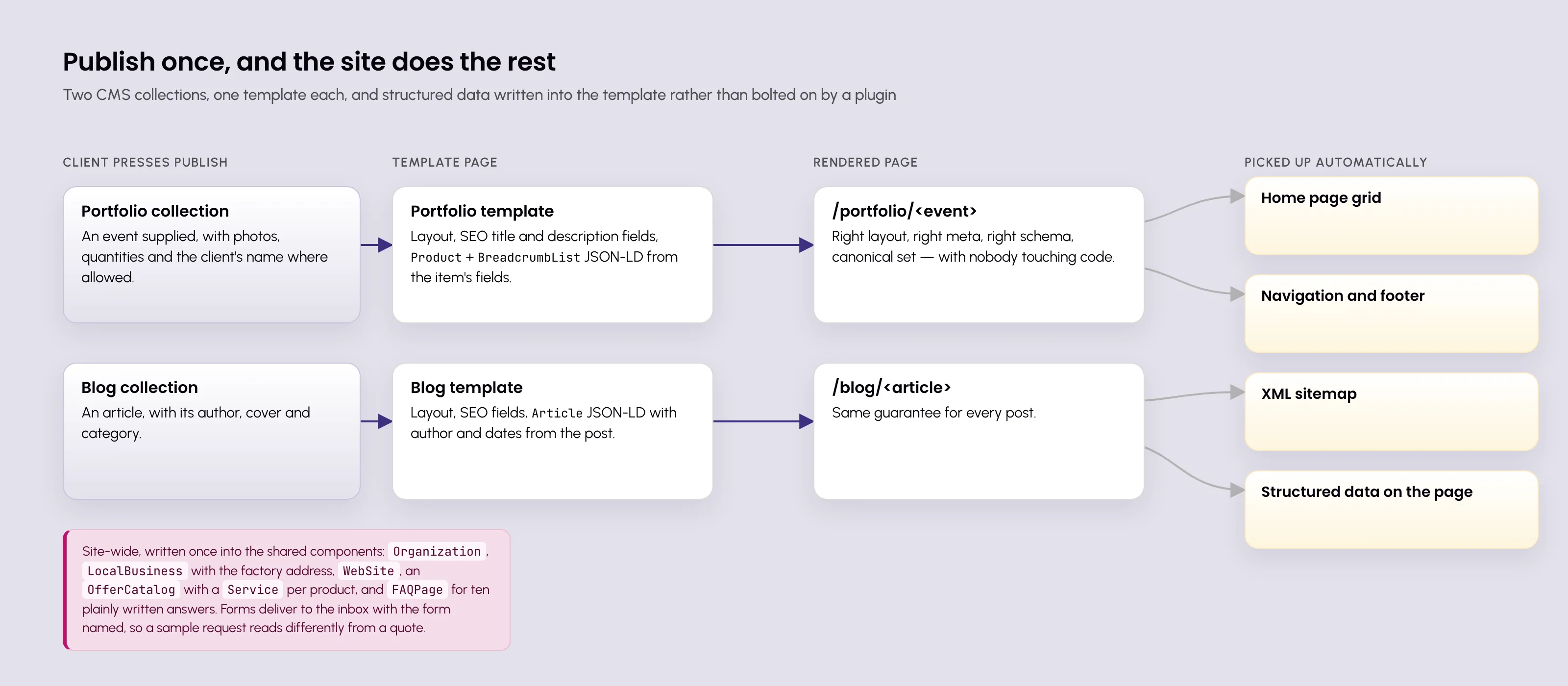
Built in Webflow from the Figma file, on a component structure that maps back to the Relume sections, so a change to a section in the design is one change in the site. Two CMS collections, Portfolio and Blog, each with its own template page: a new event or article gets the right layout, SEO fields and structured data the moment the client presses publish, and the home page and navigation pick it up on their own. Webflow forms deliver enquiries to the client's inbox with the form named, so a sample request reads differently from a quote. The catalogue page embeds the printed catalogue for the buyers who want to browse. Background video is served natively with a poster frame, Google Tag Manager carries GA4 and the Meta pixel, and Webflow's hosting handles the CDN, SSL and the redirects. The client has published eighteen pages since launch, eleven articles and seven event case studies, none of which needed us.
07 · Visibility
Built to be found from day one
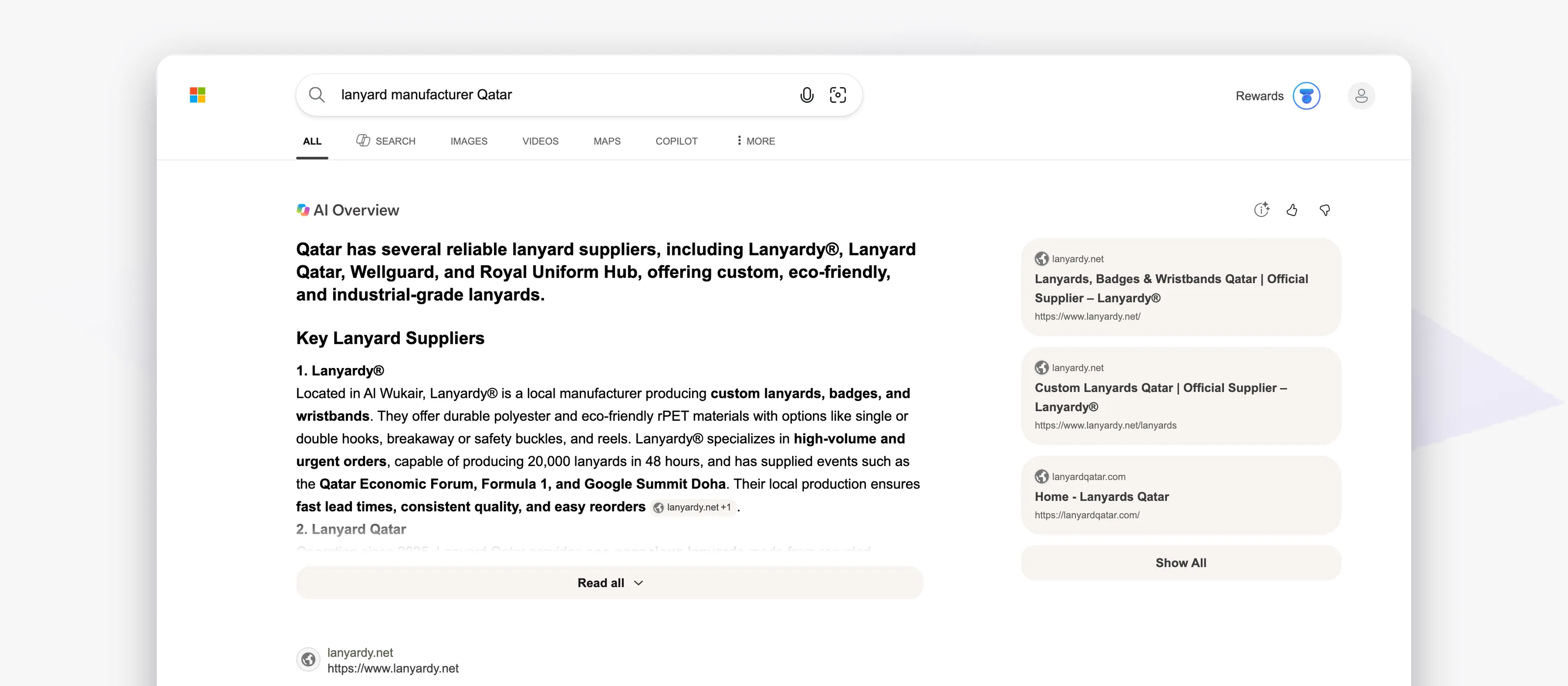
Structured data was written into every template rather than left to a plugin: Organization, LocalBusiness with the factory address, WebSite, and an OfferCatalog with a Service per product on the home page, together with FAQPage markup for ten plainly written answers; Product with its specifications as properties and a BreadcrumbList on each product page; AboutPage on the company page. Titles and descriptions lead with the facts a buyer scans for, twenty thousand in forty-eight hours, a minimum of a hundred, recycled rPET, and every commercial page names the events Lanyardy has supplied, which is the authority signal a generalist cannot copy. Canonical on every page, an XML sitemap, HTTPS throughout. The result is a site that reads the same to a person, to Google and to an assistant: in July 2026 it held first place for lanyard printing in Doha, second for custom lanyard suppliers in Qatar, and ChatGPT, Claude and Google's AI answers named it as the manufacturer, quoting the factory, the materials and the capacity from the pages.
How we approach Search & AI Visibility
08 · Pipeline
Where the enquiries go
The pipeline is the set of ways an organiser can ask. WhatsApp from the hero, from the sticky mobile bar and from the footer of every product page; a quote form that captures quantities per product; a separate sample request; a phone number that dials. Every enquiry lands in the client's inbox labelled with the form it came from. GA4 through Tag Manager and the Meta pixel give the client the page each enquiry started on and an audience to reach again in the next event season. No CRM was asked for and none was built: the sales agent works from WhatsApp, and the site sends people there.
Found first, and quoted by the assistants
- #1
- Organic result for lanyard printing in Doha; #2 for custom lanyard suppliers in Qatar.
- Named
- Recommended by ChatGPT, Claude and Google's AI answers as a Qatar lanyard manufacturer, quoting the factory and capacity from the site.
- 18
- Pages the client has published on their own through the CMS: 11 articles and 7 event case studies.
- 10
- Types of structured data across the templates, from LocalBusiness to Product and FAQPage.
Rankings are live search checks from July 2026 for the two core queries; AI answers are from test queries in the same month. The site went live in mid-2025 on Webflow. Lanyardy has supplied events since 2024, and the portfolio and blog figures are as published by the client.
Built with
- Relume
- Figma
- Webflow
- Webflow CMS
- Webflow Forms
- Schema.org JSON-LD
- Google Tag Manager + GA4
- Meta Pixel
- WhatsApp deep links