Case study
433 reviews on Google, and a blank page at its own address
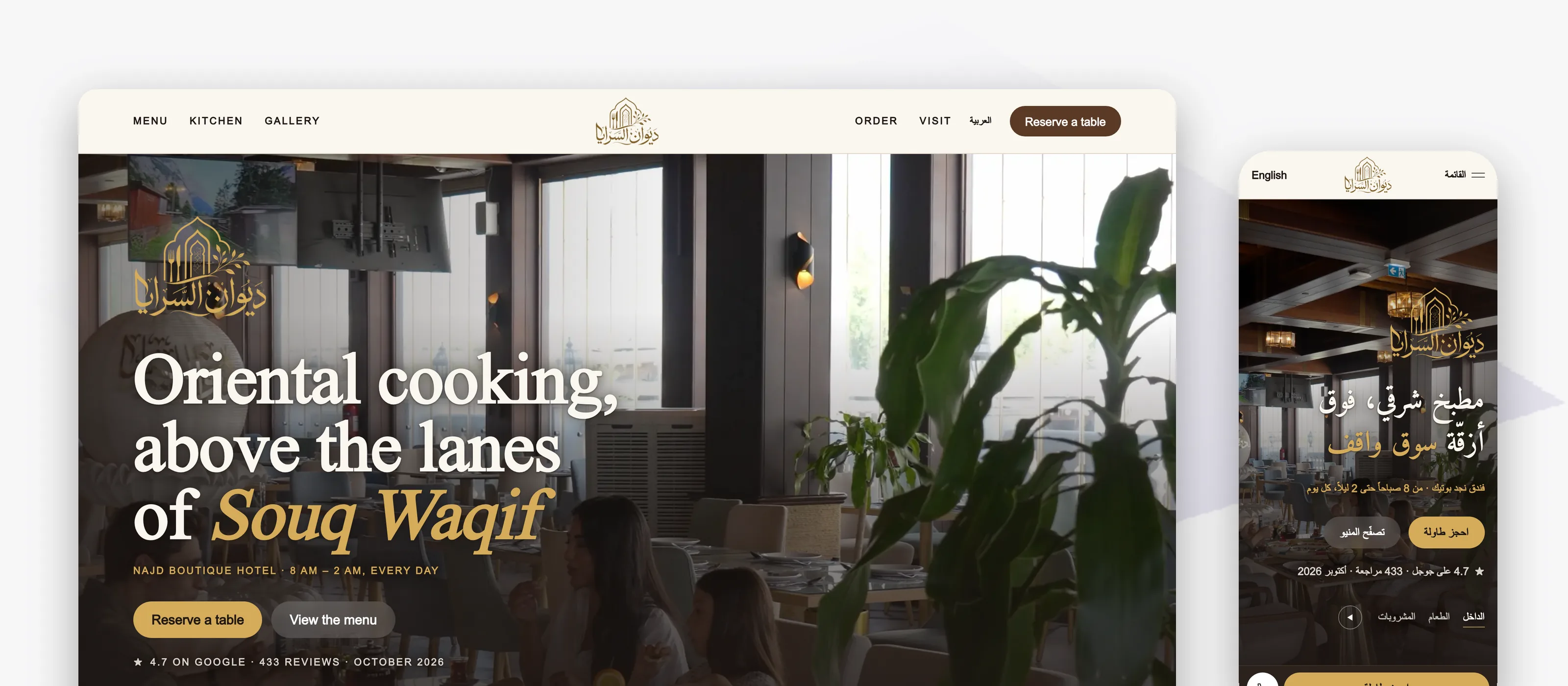
Diwan Al Saraya serves oriental cuisine on the second floor of Najd Boutique Hotel in Souq Waqif, every day from eight in the morning to two at night. In October 2026 it held a 4.7 rating from 433 Google reviews, yet its own domain showed an empty WordPress page and its Google listing sent visitors to a menu on a third-party app. We built it a bilingual site around one action, booking a table, put the whole menu on it, and took it live three days after the first commit.
- Client
- Diwan Al Saraya
- Industry
- Restaurants
- Location
- Souq Waqif, Doha
- Services
- Web design · Local SEO · Design
- Website
- diwanalsaraya.com
01 · The challenge
A well-reviewed restaurant with an empty website
Diwan Al Saraya opened in May 2024 on the second floor of Najd Boutique Hotel, at the west entrance of Souq Waqif. By October 2026 it had a 4.7 rating from 433 Google reviews and a 147-dish menu on a third-party menu app, while its own domain showed an empty WordPress page and its Google listing sent visitors to the menu app instead. The basics did not agree: the intake form gave one phone number, Google and Instagram another. The public profiles called the food Syrian; the manager's word was oriental. A guest in the souq with a phone had no single place to check the menu, the hours or how to book.
02 · Objectives
What we set out to do
- One site, in Arabic and English, where every page leads to booking a table.
- The full menu with its prices, easy to read on a phone.
- One address, phone and set of hours, the same on the site, in its structured data and on Google.
- Fast on mobile data, and live inside the contract's four weeks.
03 · Discovery
How we found the real problem
The build started from what was already public: the online menu gave all 147 dishes in sixteen sections with dine-in prices, and the Google listing gave the hours, the pin and the rating. On day one we wrote 23 questions for the manager in both languages, each already standing in for a marked placeholder on the draft, so nothing waited on an answer. The answers came on 21 October: one phone number, oriental not Syrian, 30 tables inside and 20 outside, a new logo and the photographer's pictures. A study of fourteen fine-dining sites found that almost none of the regional ones had a real Arabic version.
“Every page has one job: getting a guest to a table. And the menu is the product.”
The plan, in two lines
04 · Strategy
The plan we committed to
Speed came from reuse, not shortcuts: the site runs on the architecture of one we had launched the week before, so the time went into content, design and checks. One action leads, booking a table, in the header on a computer and in a bar fixed to the foot of the screen on a phone. Booking writes the request into the guest's own WhatsApp, because a booking system was outside the contract and WhatsApp is the channel the restaurant chose. And every fact must trace to a written source, so a dish, a price or a dietary tag appears only once the restaurant has confirmed it.
05 · Design
The decisions behind the screens
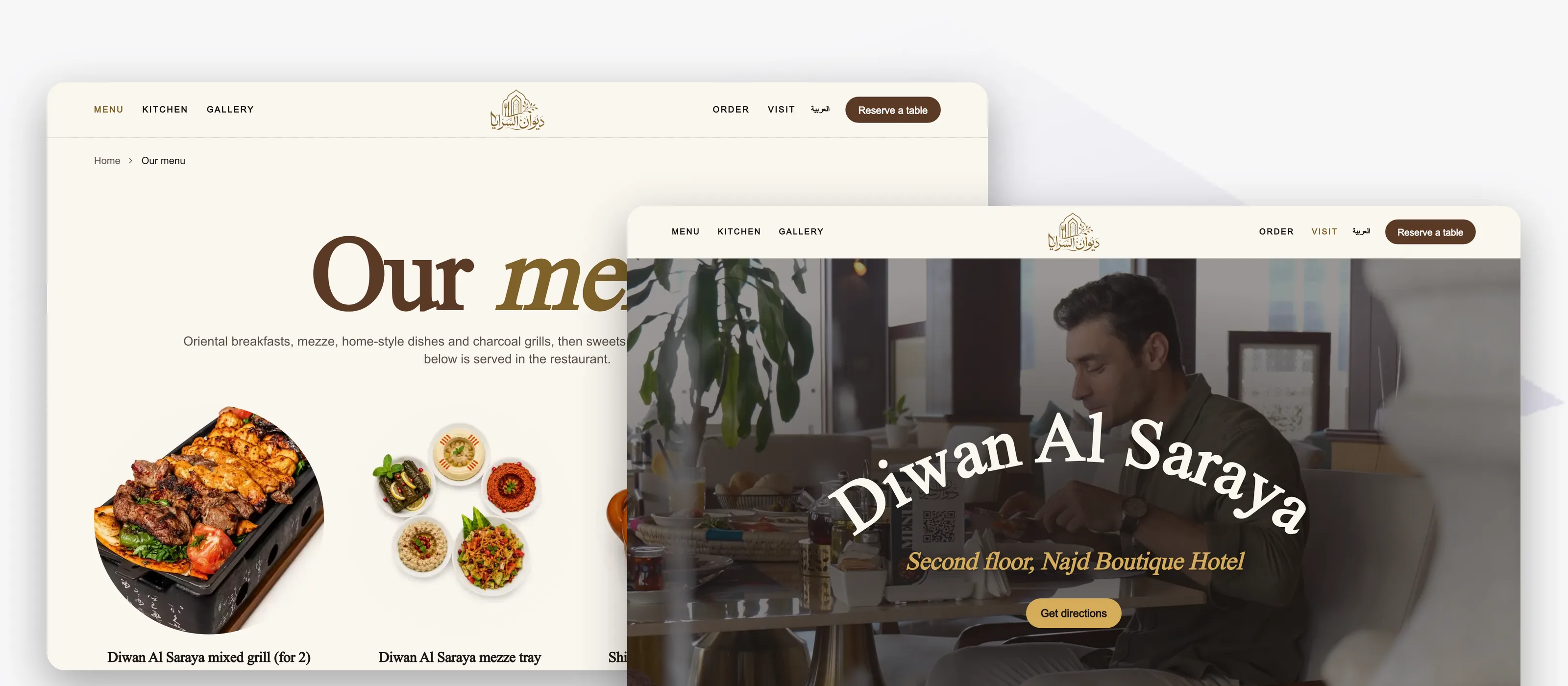
The first version used our own kit in new colours, and Amro turned it down: it looked like every other site we make. The fix kept its colours, rounded corners and type and changed the layouts. Pages now read as chapters: the dining room full-bleed, then one idea per section, one image, one heading, one link, on grounds that alternate between ivory, sand and dark walnut, with the dark brown and gold of the restaurant's own brand. The home page opens on timed slides of the room, the food and the drinks, with a pause button, and stays still for visitors who ask for less motion. The first design review reached the restaurant as 32 screenshots: every page, on phone and computer, in both languages.
How we approach Design & Development
06 · Development
What we built it on
Next.js 16 compiled to static pages, React 19, strict TypeScript and Tailwind CSS 4, with no framework JavaScript in the browser. Content sits in structured files with English and Arabic side by side, and the build refuses to finish if either is missing. The restaurant's details live in one place, and a check fails if a second phone number appears anywhere. The site is served from Cloudflare, and the domain moved with every record carried over, so the restaurant's email kept working. Before launch, 164 of 166 browser and accessibility tests passed in both languages, two skipped, and Lighthouse's mobile profile scored the five heaviest pages 90 to 98, with no layout shift and no blocking time.
07 · Visibility
Built to be found from day one
Search was built into the launch, not added after it. Every page has its own title, description and heading in its own language, and reciprocal hreflang. Structured data describes a Restaurant with its cuisine, hours, map, reservations and menu, and the menu page carries the full Menu, every dish with its price. The Google rating appears as dated text, never as review markup. The address, phone and hours match the Google Business Profile, and the site links to the restaurant's own listing on Maps. On launch day the domain was verified in Search Console and the sitemap submitted, and search and AI crawlers were confirmed to reach every page. On 14 November 2026, about three weeks after launch, the founders found Diwan Al Saraya first on Google for "restaurant in Souq Waqif".
08 · Pipeline
Where the enquiries go
Every way to the table is a plain link that works before any script loads. The booking form asks for the date, time, party size, seating, name and mobile, then opens WhatsApp with the request written out; the guest presses send and the restaurant confirms. If WhatsApp does not open, the page offers the phone number. Delivery goes to talabat, Snoonu and Rafeeq; a fourth app stays off until the restaurant confirms a working page there. Still to come: terrace and majlis photographs, the vector logo, and bringing the restaurant's other profiles in line with the site.
Live in three days, found in three weeks
- #1
- On Google for "restaurant in Souq Waqif", as of 14 November 2026, about three weeks after launch.
- 3 days
- From the first commit on 19 October 2026 to the live site on 22 October, inside a four-week contract window.
- 147
- Dishes in 16 sections, with prices, in Arabic and English, each checked against the restaurant's own online menu.
Build dates are from the project's commit history and client log: first commit 19 October 2026, live on 22 October. The menu count is from the site's own menu, checked dish by dish against the restaurant's online menu on 21 October. The ranking is the founders' own check of Google on 14 November 2026 for "restaurant in Souq Waqif". No ongoing search work had started by then: the result rests on the launch build alone.
Built with
- Next.js 16
- React 19
- TypeScript
- Tailwind CSS 4
- Schema.org JSON-LD (Restaurant + Menu)
- Cloudflare
- Playwright + axe
- Lighthouse CI
- Google Search Console