Web design8 min read
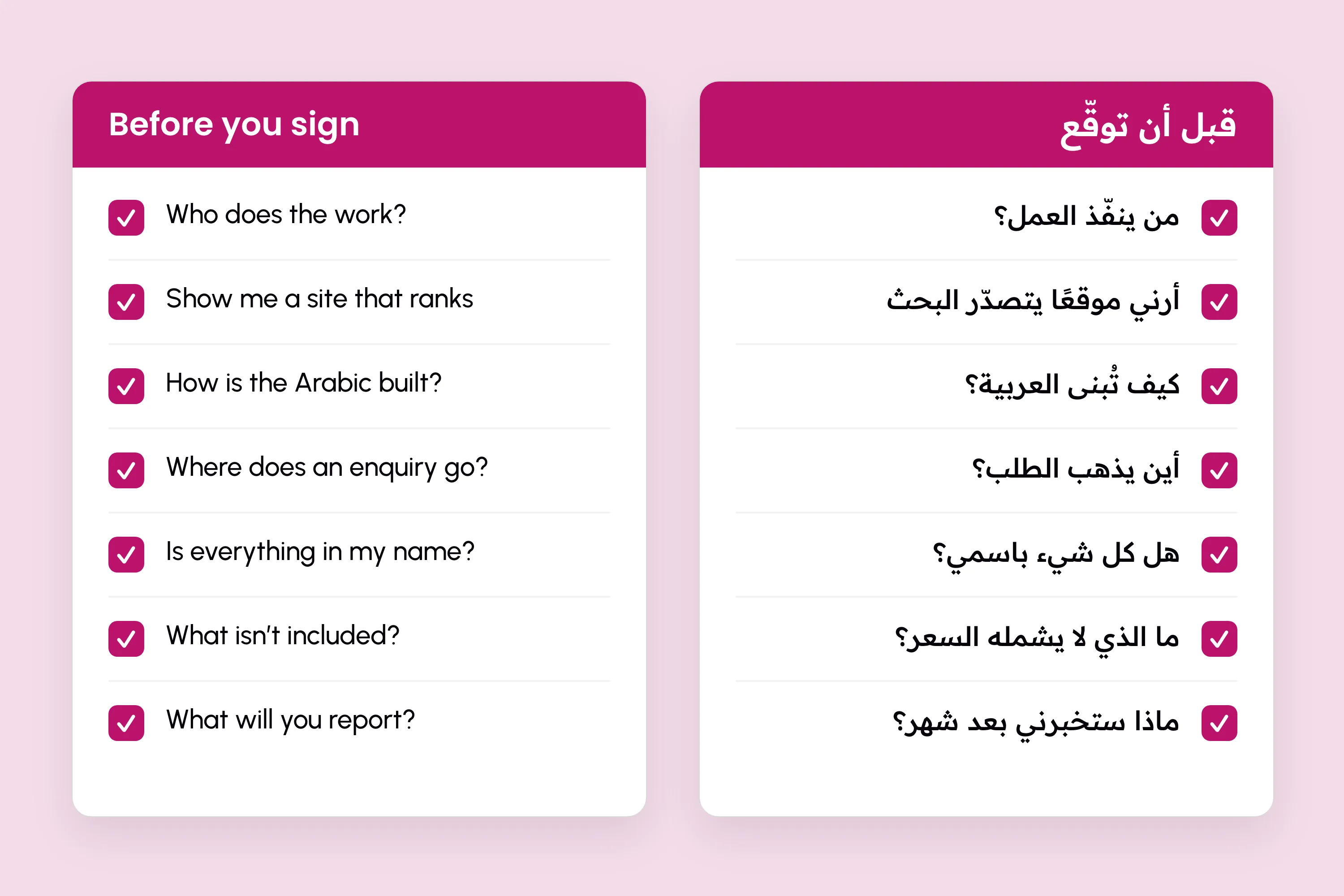
How to choose a web design company in Qatar
Seven questions that show which agency will build a site that brings you customers, what to listen for in the answers, and the five kinds of agency you'll meet in Doha.
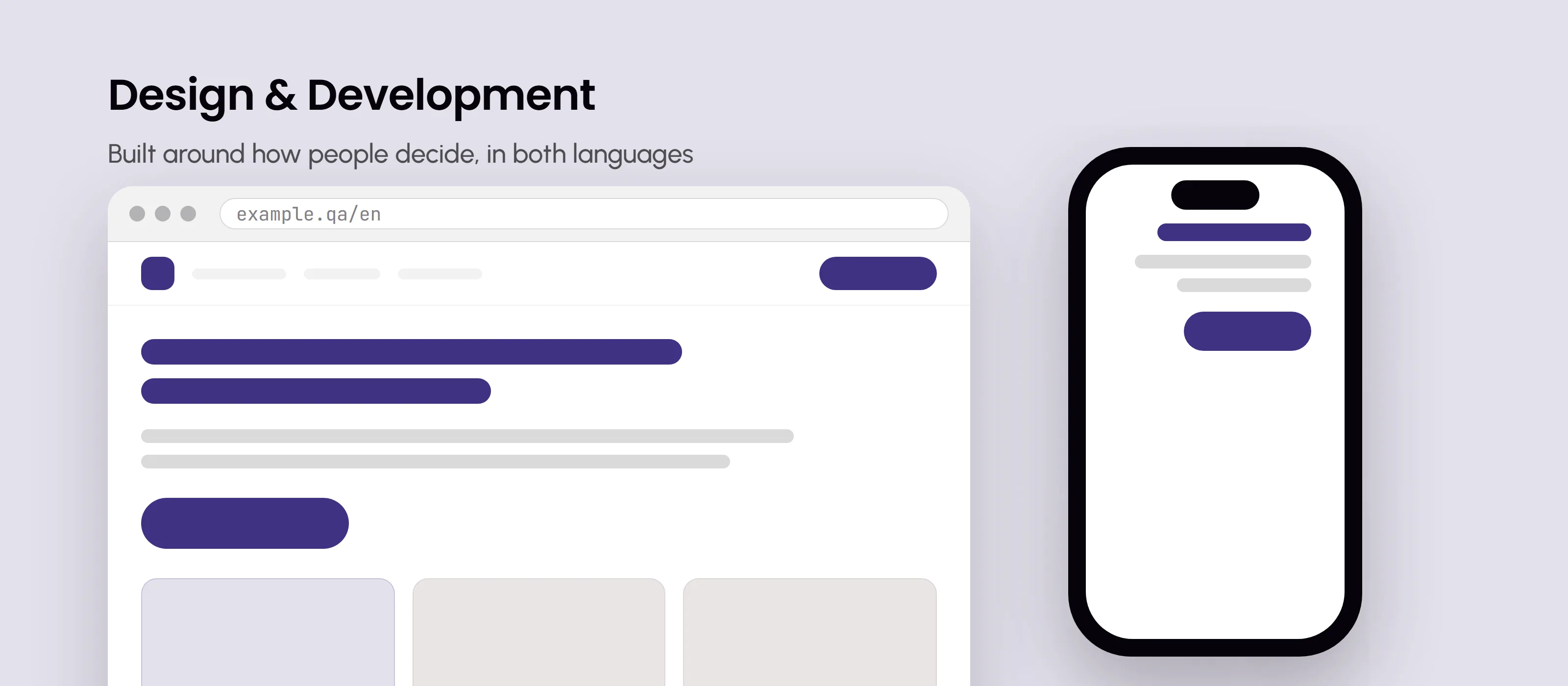
Read the postDesign & Development
Bilingual sites designed right-to-left from the first layout, not translated at the end.
7
projects shipped across Qatar and the GCC



Design, search visibility and pipeline — built together, in English and Arabic.
Definition
An Arabic-first website is one where the Arabic is designed, written and tested alongside the English, not produced from it at the end. Both languages share one structure, each has its own address (/ar for Arabic), and switching language keeps the visitor on the same page.
It gets right what translation never touches: direction, mixed Arabic and Latin text, Arabic typography, text length, one digit style, and search signals such as hreflang. It differs from a translated site, and from Arabic SEO, which ranks those pages over time. The demo above shows one page in both directions.
Why it matters
A site laid out for English and mirrored afterwards breaks in predictable ways: text overflows its buttons, icons point the wrong way, and numbers sit backwards inside sentences. Visitors read that as a site not built for them. It costs you in search too, because Arabic buyers type their own words, not translations of the English ones.
Someone after a bilingual site types «تصميم موقع عربي انجليزي», often without the hamza. A translated keyword plan misses them.
Masas launched in 14 days with 104 pre-rendered pages in English and Arabic, built from the same components.
Reciprocal hreflang on all 94 of Masas's sitemap URLs lets each language rank for its own searches.
Every page on this site exists in both languages, and the Arabic is written for Arabic readers.
How it runs
Neither language waits for the other: every step covers both.
What buyers type in English and, separately, in Arabic. The lists rarely match, so each page gets a target in each language.
One sitemap, with each page's Arabic and English address, name and main action decided together.
Both languages written from one brief by writers in each. From you: someone who approves the Arabic as it arrives.
Every component checked right to left and left to right: the mirror, the icons that stay put, the labels, the Arabic type.
Mixed text in order, +974 numbers readable, forms that accept Arabic names, and error messages in the visitor's language.
lang, dir and hreflang on every page, both languages in the sitemap, and both submitted to Google Search Console.
What it costs
Site from QAR 8,000 and Site + system from QAR 15,000 both include Arabic and English, as fixed prices agreed before work starts.
A worked example
An example business, the stone-cladding contractor in the demo above, not a client.
example.qa/en and example.qa/ar are one page, paired with hreflang. The switcher on facades leads to the Arabic facades page.
The logo moves right, the menu follows, and Get a quote crosses left. The villa, facade and interior cards run right to left.
A play button, a checkmark and the phone number keep their direction. Arrows meaning next turn to point left.
In «اتصل بنا على +974 …» the number keeps its order, isolated so the browser cannot reorder it.
English buyers search for a contractor. Arabic buyers search «حجر سوري للواجهات» or «سعر متر الكلادينج في قطر», so the Arabic site gets a stone guide.
A translated keyword list would have targeted «مقاول تكسية حجر الدوحة», which hardly anyone types.
Check your site
Run it on your own site, or on a supplier's past work before you hire them, with a phone.
Bilingual UX and layout designed in parallel
Arabic typography chosen, sized and spaced for Arabic
Mirrored layouts, with the icons that must not flip left alone
Mixed-direction text handled: names, phone numbers, prices
Arabic keyword research and copy written in Arabic
A language switcher that keeps the visitor on the same page
hreflang, lang and dir on every page, in both languages
Forms, error messages and emails tested in Arabic on real phones
From the blog
Guides written by the founders who run the projects, not by a content team.
Seven questions that show which agency will build a site that brings you customers, what to listen for in the answers, and the five kinds of agency you'll meet in Doha.
Read the postBoth languages are in the price, not an add-on. Our websites start from QAR 8,000 as a one-off project with Arabic and English included, or from QAR 15,000 with enquiry tracking and a sales pipeline. The figure moves with page types, integrations and how much copy needs writing. Hosting and the domain are paid separately, on your own plan.
Yes, with native Arabic writers rather than machine translation. The Arabic is written for Arabic readers and Arabic searches, from the same brief as the English, so it can order ideas differently and use the words Arabic searchers actually type. If you have your own Arabic writer, we can work from their copy and check it fits the layout and search plan.
You can, but it costs more overall. Every component has to be checked again in the other direction, text that fits in English overflows, and the switcher and hreflang are added to pages not built for them. If you must launch in English, we build the structure for both from day one, so adding Arabic later is content, not a rebuild.
Most projects take four to eight weeks from kickoff to launch, both languages together, because they are built in the same pass. Masas went live in 14 days, with 104 pages in English and Arabic, because its content was ready. The usual delay is Arabic copy that arrives late or is approved only at the end, so agree early who signs off each language.
Yes. Each language has its own URL (here, /ar for Arabic), linked to its twin with hreflang, so Google can rank each for searches in its own language. A single address that swaps language with a cookie or a button is invisible to search in one of the two. Check yours: switch to Arabic and watch the address bar. If it does not change, search cannot see the Arabic.
No. A translation plugin translates text on a finished page. It doesn't mirror the layout, fix mixed-direction text, choose an Arabic typeface or research Arabic keywords, and those are what visitors notice. Many plugins also serve Arabic from the same address or translate in the browser, which search engines may never see. A plugin can be a stopgap; it is not a bilingual site.
Every part of Design & Development works better alongside the others — here's the rest of it.
15 minutes · A clear next step · No pressure