



Skip to content

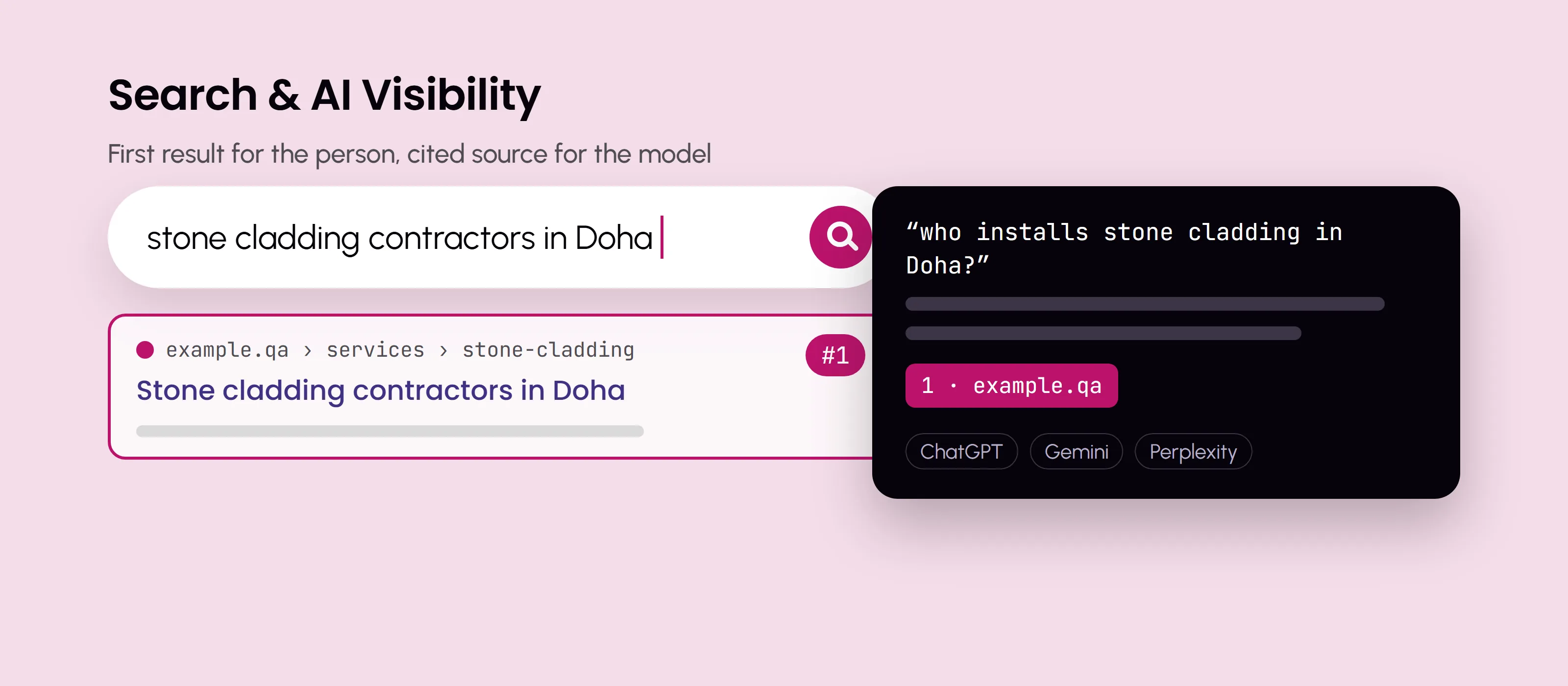
Search & AI Visibility

Arabic SEO in Qatar

Arabic keyword strategy researched in Arabic — not translated from the English plan.

Search plan · example.qaDemo · example site

How does the buyer search?

They type

حجر سوري للواجهات

What they want
A material, not a service
The page that answers
/ar/guides/syrian-vs-jordanian-stone
Competition
Few good answers

A translated list would targetمقاول تكسية حجر الدوحةA translation of the English, and hardly anyone types it.

/facades and /ar/facades are paired with hreflang, so each ranks on its own.

7

projects shipped across Qatar and the GCC

  • Auckland
  • Lanyardy
  • Bushra Pharmacy
  • Masas Trading & Contracting
  • Ottora Studio

Design, search visibility and pipeline — built together, in English and Arabic.

Definition

What Arabic SEO involves

Arabic SEO is the work of being found by people who search in Arabic. It has three parts: research done in Arabic, into how people actually phrase what you sell; a structure that lets the Arabic pages rank on their own, paired with the English through hreflang; and measurement kept apart for each language.

It is not the same job as building an Arabic and RTL website, which makes pages read and work right to left. Arabic SEO decides what those pages target, and makes sure search engines can find them.

Why it matters

Why a translated keyword list underperforms

Arabic buyers often search for a material, a place or a price, not a type of company, so a translated keyword list targets phrases nobody types. Those Arabic searches often carry far less competition, because few businesses in Qatar write pages for them. The demo above shows one buyer searching three ways, and our guide explains the method.

  • A material, not a service

    The Arabic buyer types «حجر سوري للواجهات» where the English buyer types "stone cladding contractor Doha".

  • A loanword, not a translation

    Buyers type «سعر متر الكلادينج في قطر», where a translated list would target «تكلفة تكسية الواجهات».

  • Arabic beat English

    On a Doha contractor's site, the Arabic stone guide was September 2026's most-clicked page: 692 impressions and 13 clicks, ahead of the English home page.

  • Two versions, one business

    Paired with hreflang, the English and Arabic pages each rank on their own instead of competing for the same query.

How it runs

Research, structure, content, then measurement

We need Search Console access, your customers' Arabic questions with names and numbers removed, and someone to confirm your Arabic product names.

  1. Week 1: research

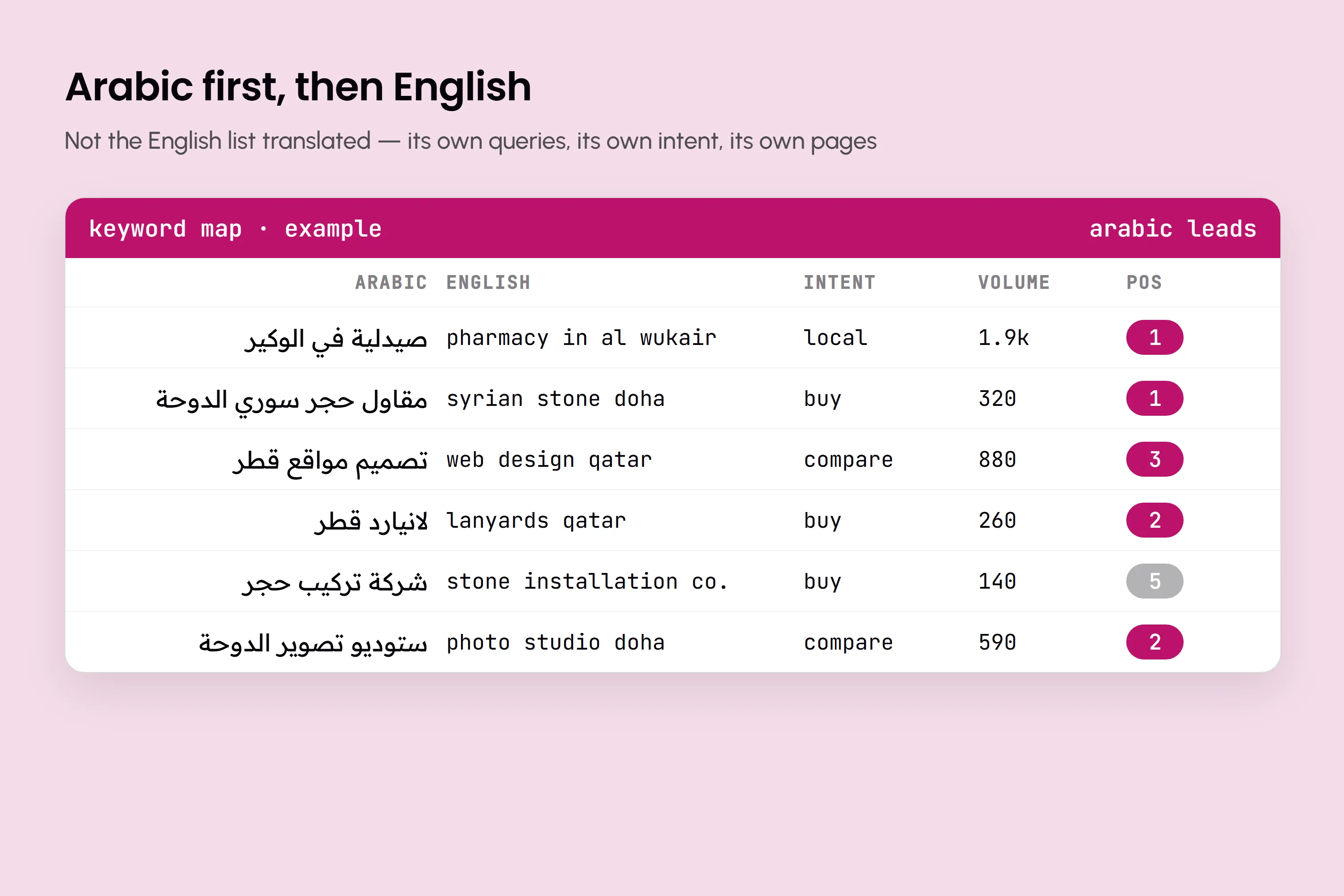
    Google's suggestions, People also ask, Arabic forums, and tool data as a direction. You get a keyword map: query, intent, page.

  2. Week 2: structure

    Arabic URLs, titles and descriptions for each page, hreflang and canonicals checked one by one. URLs that already carry history stay put.

  3. Weeks 3 to 6: content

    Pages with demand and no answer are written in Arabic from our briefs; pages that read as translations are rewritten.

  4. Every month: measurement

    Rankings, impressions and enquiries for each language, side by side, in Search Console and in the report.

Common mistakes

What hides the Arabic version, and what lets it rank

To check your own site, filter the Pages report in Search Console to URLs containing /ar/ and compare the count with the English.

Hides the Arabic

  • One URL for both languagesA switcher swaps the text on the same address, leaving one page in the index, usually the English.
  • hreflang that does not point backGoogle ignores a pair that is not returned by the other page.
  • An Arabic canonical pointing to EnglishGoogle reads the Arabic page as a copy, and leaves it out.
  • English titles on Arabic pagesThe parts shown in results were never written in Arabic.

Lets it rank

  • Its own address under /arThe same path with its own URL, so each language can be indexed and ranked.
  • Pairs that point both waysEach page names its partner with hreflang, and the partner names it back.
  • A canonical that names itselfEach Arabic page names itself as the main version of the Arabic page.
  • Arabic titles, Latin slugsTitles written for the Arabic query; Latin slugs survive being pasted into WhatsApp intact.

What Arabic SEO includes with us

The same site as the first Google result and as the source an AI answer names

Keyword research done in Arabic, with intent, spelling variants and dialect terms

A keyword map: each Arabic query, what the buyer wants, the page that answers it

Arabic URLs, titles and descriptions written for the Arabic query

hreflang and canonical pairing on every English and Arabic page, checked one by one

Arabic content briefs: the query, the intent, the outline, the terms

The same Arabic business name on the pages, in the schema and on the Business Profile

Rankings, traffic and enquiries reported per language, side by side

From the blog

If you'd rather read first

Guides written by the founders who run the projects, not by a content team.

Search9 min read

How to rank an Arabic website in Qatar: what works

Translating your English pages into Arabic will not rank them. Arabic SEO is a different keyword set, a different page structure and a different layout — here is what it looked like on a real Doha site, with the numbers.

Read the post

Common questions

Should the Arabic site have its own URLs?

Yes. Each language needs its own crawlable address, usually the same path with /ar in front, and each page should name its partner with hreflang. Google then shows the Arabic page to Arabic searchers and the English to English ones. A switcher that swaps text on one URL gives Google a single page, normally the English. Subfolders on one domain are simpler than a separate Arabic domain.

Is Arabic search less competitive?

Often, yes. Few businesses in Qatar publish Arabic pages written for Arabic queries, so many of those searches have few good answers. It is an opportunity, not a shortcut: keyword tools hold thin Arabic data for Qatar, so demand is easy to misjudge. The reliable test is to publish a page for a real query and watch its impressions in Search Console for a few months.

Should the pages use Gulf dialect or standard Arabic?

Write the pages in clear Modern Standard Arabic, which every Arabic reader in Qatar reads comfortably and which suits a business site. Then use the words customers actually type where they fit: in headings, FAQ questions and product names. Avoid whole pages in dialect to chase keywords; they read as forced, and the dialect terms that matter are few enough to place well.

What does Arabic SEO cost?

Arabic SEO is included in our Standard plan: QAR 3,000 a month, or QAR 2,500 a month paid yearly, with a three-month minimum, six recommended, and no exit fee after that. The plan covers both languages. If your site has no Arabic version yet, building one is a separate project, quoted at a fixed price once we have seen the site.

Can you work with our existing Arabic translations?

Yes. We keep what reads naturally and rewrite only where the query, the title and the text don't match: usually the service pages, rarely the About page. Titles and descriptions are often the first fix, because they are what searchers see in results. If the translation is machine output throughout, we will say so, and rewriting the main pages becomes the first months' content work.

Who writes the Arabic, and can we write it ourselves?

You can, and often should, because nobody knows the Arabic names of your products better than the people selling them. We write a brief for each page: the query, what the buyer wants, the outline, the terms and the questions to answer. You or your writer fill it in, and we review it before it goes live. If we write it, it is written in Arabic, never machine-translated.

Ready to be found where people actually look?

15 minutes · A clear next step · No pressure