Sales Pipeline
CRM setup in Qatar
A pipeline that matches how you actually sell, not how a tool assumed you do.
New1
Majlis wall, Lusail
WhatsApp
- Alert sent to Yousef
- Call back by 09:00
YousefQAR 12,500
Contacted1
Shop front, Msheireb
Website form
MariamQAR 22,000
Proposal1
Villa facade, Al Waab
Google Maps
MariamQAR 48,000
Won1
Office lobby, West Bay
Instagram ad
YousefQAR 31,000
7
projects shipped across Qatar and the GCC





Design, search visibility and pipeline — built together, in English and Arabic.
Definition
What CRM setup involves
A CRM is the shared record of every enquiry and deal: who asked, what they want, who is handling it and what happens next. Setting one up is four decisions: which system, which stages a deal passes through in your words, how enquiries get in from the website, WhatsApp and email with their source, and who uses it for what.
It is not a contact list. Contacts record who someone is; a CRM records where each sale stands. It also differs from lead tracking, which finds where an enquiry came from. The CRM keeps that answer next to the deal.
Why it matters
Why most CRMs quietly go unused
Every CRM asks people to type, and when the typing only helps the owner reading a report, people stop and the data goes stale within weeks. Zoho, HubSpot, Pipedrive and the rest all work, and they all fail for the same few reasons. A quick test: if most open deals haven't been touched for two weeks, the system isn't being used.
Stages in the tool's language
Qualification and Needs analysis mean nothing to a team that says visited site and sent price.
Too many required fields
Each one is a reason to log the deal later, which in practice means never.
WhatsApp left outside
The real conversation stays on a phone, and the CRM becomes a copy nobody keeps up to date.
How our own studio runs it
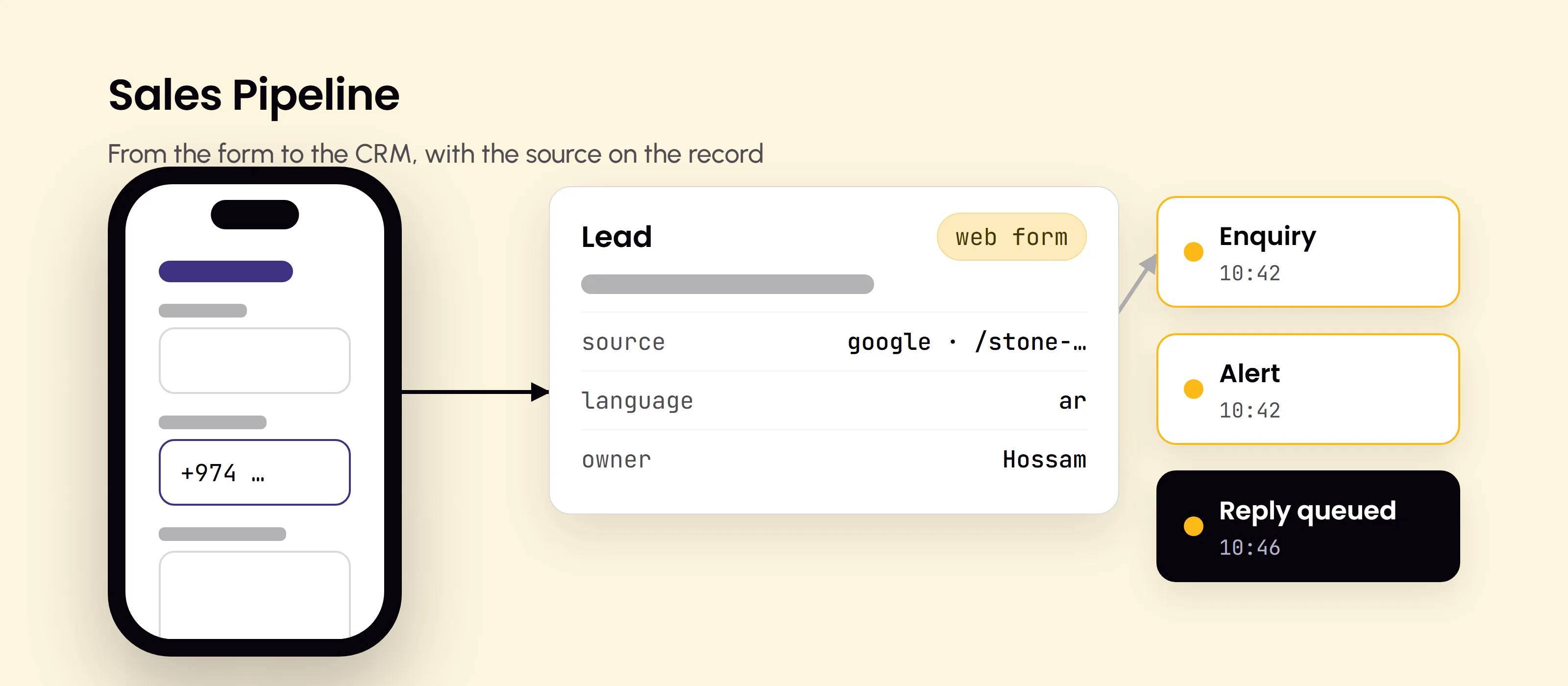
An enquiry becomes a deal by itself, with its page and campaign, and a founder's phone is alerted the moment it arrives.
How it runs
Four weeks, and what we need from you
Each week produces something you can check, and asks one thing of you.
Week 1: how you sell
We map the real stages and exits with whoever takes and closes enquiries, then recommend a system with its monthly cost. From you: an hour each.
Week 2: the build
Stages, fields, owners and loss reasons. Form, WhatsApp and inbox connected, so each enquiry becomes a deal with its source. From you: access.
Week 3: migration and walkthrough
Contacts and open deals moved, duplicates merged, phone numbers in one format, and a recorded walkthrough. From you: an export of the sheet or old system.
Week 4: the first report
Deals by stage and source, reply times, and what closed and where it started.
A worked example
A WhatsApp-first sales process, as stages
In the example pipeline above, each stage is defined by something that happened, never by a feeling such as warm.
New
A message, form or call has arrived. The CRM assigns an owner, alerts them and sets a call-back task.
Contacted
A person, not an automatic reply, has spoken to the customer and knows what they want and where.
Proposal
A written price has been sent. A PDF over WhatsApp counts, as long as it is logged with its value.
Won
The customer has confirmed in writing or paid a deposit.
Lost, always with a reason
Price, timing, another supplier, no reply after two chases, or not something you do. After a quarter, this list says more than any report.
Add a stage only for a real step
A business that measures on site adds Site visit before Proposal. If two people would disagree on a deal's stage, rewrite the rule.
At handover
What you own when we hand over
Everything is set up in your name from the first day, so nothing needs transferring later.
- The CRM account in your company's nameBilled to you directly by its maker, not through us.
- The main admin loginOur access is an ordinary user you can remove at any time.
- The recorded walkthroughFor the team now, and for anyone who joins later.
- Your data, exportableContacts, deals and their history can be exported whenever you choose.
What CRM setup includes with us
Stages in your team's words, each with a rule for what moves a deal
Website form, WhatsApp and email connected; every lead keeps its source
An owner, an alert and a call-back task for every new enquiry
A short list of loss reasons, so a lost deal still teaches you something
Contacts and open deals moved from sheets or the old system, duplicates merged
A recorded walkthrough, so the team uses the system rather than avoids it
A weekly view of deals by stage and source, and of reply times
The CRM account, its billing and your data in your company's name
Common questions
Which CRM should we use?
Whichever fits your process and budget; Zoho, HubSpot, Pipedrive and the rest all work. Ask four questions: does it take WhatsApp conversations through a provider that works in Qatar, does it work well on a phone, what does it cost for the people who actually sell, and can you export everything. We recommend one, with its monthly cost, before you commit. We don't resell licences.
We already have one nobody uses. Can it be saved?
Usually, and for less than replacing it, because the problem is almost always the configuration, not the tool. We start by reading what is there: open deals, last activity, required fields and unused stages. The fix is mostly removal: fewer fields, stages in your words, stale deals closed with a reason, and WhatsApp brought inside.
What does CRM setup cost?
With a new website, from QAR 15,000: the published "Site + system" package, which is the site plus the tracking and pipeline. For a site you already have, it is a fixed price quoted after a short call. Scope is set by how many channels connect, whether a WhatsApp Business API account exists, and how much history moves over. The software is billed by its maker, per user.
How long does it take?
About four weeks: how you sell, the build, migration and the walkthrough, then the first report. Two things keep it on time: access to the website, the inboxes and any WhatsApp Business API account in the first week, and a clean export. A spreadsheet kept by three people over three years needs sorting before it moves.
Do you connect WhatsApp?
Yes, where your WhatsApp Business API account is in place. The free WhatsApp Business app runs from one phone and can't pass chats to a CRM on its own. The API, used through a provider, can, and lets several people answer from one number. Without it, whoever takes a WhatsApp enquiry logs it in one tap, with its source.
Will the CRM be in Arabic?
Your customers' names and messages can be in Arabic in any modern CRM. Arabic screens for your team, and how well Arabic names are searched, vary by product, so a team that prefers Arabic narrows the choice, and we say so before you commit. Store every phone number as +974 and eight digits, so one customer is matched across channels.
Do we need a custom CRM?
Rarely. An off-the-shelf CRM set up properly suits a small team, because someone else maintains it and its phone app. Custom makes sense when sales and operations share the same records, as at Ottora Studio, where a booking, a camera and a deal live in one system. If your sales end in jobs your operations team must schedule, ask that question first.
More in Sales Pipeline
Every part of Sales Pipeline works better alongside the others — here's the rest of it.
- Lead tracking & attributionKnow which search, post or ad produced every enquiry, and which ones became customers.
- Marketing automationEvery enquiry answered fast and followed up on time, without anyone having to remember.
- Conversion optimisationMore of the visitors you already have get in touch, on WhatsApp, by phone or through the form.
Ready to see where the money goes?
15 minutes · A clear next step · No pressure